How to Create a Meal Plan: Step-by-Step Guide
· 11 min read
Learn how to build a flexible, goal-driven nutrition plan step by step. Calculate your calories, distribute your macronutrients, and establish habits that fit your daily routine.
A structured nutrition strategy turns vague fitness ambitions into manageable daily habits without forcing you to stress over every bite. Learning how to create a meal plan comes down to understanding your actual energy needs and building flexible guidelines rather than locking yourself into rigid rules. In this guide, you will learn step by step how to calculate your calorie target, balance your macronutrients, and establish a modular meal framework that works in the real world.
Why Rigid Diets Fail and What Makes a Meal Plan Sustainable
Many pre-made diet sheets downloaded from the internet fail against one predictable obstacle: everyday life. They mandate that you eat exactly 150 grams of chicken breast and 80 grams of steamed broccoli at 12:30 p.m. every Tuesday. The moment you face a client lunch, an invitation out with friends, or an unexpected overtime shift at work, the entire structure collapses.
A realistic, modern nutrition plan is built on overarching principles rather than unchangeable daily menus. It provides clear parameters for your daily energy and nutrient intake while leaving you the freedom to swap ingredients based on personal preference, digestive tolerance, and schedule.
The Three Pillars of a Lasting Plan
- Energy Balance: Your total caloric intake primarily determines whether you lose weight, maintain your current physique, or gain body mass.
- Nutrient Density: Adequate protein supports muscle maintenance and growth, while essential fatty acids, carbohydrates, dietary fiber, and micronutrients support normal hormone production, digestion, recovery, and training performance.
- Practicality: If your meals taste bland or demand hours of complicated kitchen prep every day, you will likely abandon the routine within a few weeks. Consistency over months always outperforms short-term perfection.
Step 1: Calculate Your Baseline Calories and Adjust for Your Goal
Before measuring food portions or planning recipes, you need a reliable estimate of your daily energy expenditure. Your total daily energy expenditure (TDEE) is made up of your basal metabolic rate (BMR)—the energy your body burns at complete rest for vital functions like breathing, circulation, and cellular repair—multiplied by your physical activity level.
A Simple Starting Estimate
For a practical estimate without complex formulas, use this reliable rule of thumb for individuals with moderate daily movement and 2 to 4 strength or conditioning workouts per week:
- Daily Maintenance Calories: Body weight in kg × 30 to 34 kcal (or roughly body weight in lbs × 14 to 15.5 kcal)
For example, an individual weighing 70 kg (154 lbs) working an office job and training three times per week will have an estimated maintenance intake of roughly 2,100 to 2,380 calories per day. This number serves as a baseline that you will test and refine over the first two to three weeks by tracking your average body weight and energy levels.
Adjusting Calories to Match Your Objective
Once you have established your estimated maintenance baseline, adjust your daily intake according to your primary goal:
- Fat Loss (Caloric Deficit): Subtract 300 to 500 calories from your maintenance level. A moderate deficit often supports steady fat loss of about 0.25 to 1 percent of body weight per week, depending on your starting size, activity level, and adherence, while reducing the risk of excessive hunger, low energy, and large performance drops in training.
- Muscle Growth (Caloric Surplus): Add 200 to 350 calories to your maintenance level. A controlled surplus provides your body with the extra energy and raw material required to synthesize new muscle tissue while keeping unwanted fat gain to a minimum.
- Body Recomposition / Weight Maintenance: Eat at your maintenance level. Beginners to structured lifting or individuals returning after an extended training hiatus can often build muscle and drop body fat concurrently at maintenance calories.
Step 2: Set Your Macronutrient Targets
While total calories set the boundary for body weight changes, your macronutrient distribution—protein, fat, and carbohydrates—determines how full you stay, how well you recover from training, and your overall body composition.
Protein: The Building Block for Muscle and Satiety
Protein is the most critical macronutrient for active people. It supplies the essential amino acids needed for muscle protein synthesis, protects existing muscle mass during a calorie deficit, and has the highest thermic and satiating effect of all nutrients.
- Target Range: 1.6 to 2.2 grams of protein per kilogram of body weight per day (roughly 0.7 to 1.0 grams per pound).
- Example (70 kg individual): 70 × 2.0 g = 140 g of protein daily. Because protein provides roughly 4 calories per gram, this equals 560 calories.
Dietary Fat: Essential for Hormones and Cellular Health
Fats are required for absorbing fat-soluble vitamins (A, D, E, and K), supporting cell membrane integrity, and contributing to normal hormone production. Cutting dietary fat very low may negatively affect satiety and can make a diet harder to sustain.
- Target Range: 0.8 to 1.2 grams of fat per kilogram of body weight per day (or roughly 20 to 30 percent of total daily calories).
- Example (70 kg individual): 70 × 1.0 g = 70 g of fat daily. Because dietary fat provides roughly 9 calories per gram, this equals 630 calories.
Carbohydrates: Fuel for Performance and Recovery
Carbohydrates serve as the preferred energy source for high-intensity strength training and demanding conditioning sessions. They replenish muscle glycogen stores, reduce training fatigue, and support recovery.
Once your protein and fat targets are established, fill your remaining daily calories with carbohydrates:
- Start with your total daily calorie target (for example, 2,200 kcal).
- Subtract the calories assigned to protein (560 kcal) and fat (630 kcal): 2,200 − 1,190 = 1,010 kcal remaining.
- Divide the remaining calories by 4 (since carbohydrates provide 4 kcal per gram): 1,010 ÷ 4 ≈ 253 g of carbohydrates.
Step 3: How to Create a Meal Plan Using a Modular Building-Block System
Instead of forcing yourself to eat the exact same pre-determined recipe every day, use a modular building-block system. Choose your preferred daily meal frequency, then construct each main meal around one primary protein source, a generous serving of vegetables or fruit, and appropriate portions of carbohydrates and healthy fats.
Structuring Your Meal Frequency
For many people who lift weights or train regularly, dividing daily food intake across 3 to 4 meals per day is convenient and practical. This makes it easier to spread protein intake across the day and can help with fullness and meal planning. However, total daily intake matters most—if your schedule works better with two larger meals and a snack, organize your calories accordingly.
Core Food Categories for Your Framework
- Lean Protein Sources: Chicken breast, turkey breast, lean ground beef, eggs and egg whites, low-fat Greek yogurt or quark, low-fat cottage cheese, salmon, tuna, cod, tofu, tempeh, lentils, chickpeas, and whey or plant protein powder.
- Complex Carbohydrates: Rolled oats, brown or basmati rice, white potatoes, sweet potatoes, whole-grain pasta, quinoa, whole-wheat sourdough bread, berries, and bananas.
- Healthy Fats: Extra virgin olive oil, avocado, walnuts, almonds, chia seeds, ground flaxseeds, natural nut butter, and fatty fish.
- Fiber and Micronutrients: Broccoli, spinach, zucchini, bell peppers, tomatoes, carrots, cucumbers, and leafy greens. Aim for at least 400 to 500 grams of vegetables and fruit daily.
Sample Day: A Balanced 2,200-Calorie Meal Plan
The table below illustrates a realistic, well-balanced sample day totaling approximately 2,160 to 2,200 calories with 145 grams of protein. Portions and ingredients can be swapped to fit your personal numbers and dietary preferences.
| Meal | Ingredients & Preparation | Protein | Fat | Carbs | Calories |
|---|---|---|---|---|---|
| Breakfast | 80 g rolled oats, 250 g low-fat Greek yogurt (or quark), 100 g mixed berries, 15 g chopped walnuts, cinnamon | 42 g | 13 g | 68 g | ~570 kcal |
| Lunch | 150 g chicken breast fillet, 80 g brown rice (dry weight), 200 g steamed broccoli, 10 g extra virgin olive oil | 40 g | 13 g | 65 g | ~550 kcal |
| Pre-Workout Snack | 1 medium banana, 20 g natural almond butter, 1 slice whole-wheat toast | 7 g | 12 g | 42 g | ~310 kcal |
| Dinner | 150 g grilled salmon fillet, 300 g boiled potatoes, 150 g grilled zucchini or asparagus, mixed side salad with balsamic vinegar | 38 g | 22 g | 54 g | ~580 kcal |
| Evening Snack (Optional) | 150 g low-fat cottage cheese with sliced cucumber, sea salt, and fresh herbs | 18 g | 6 g | 4 g | ~150 kcal |
| Daily Total | 145 g | 66 g | 233 g | ~2,160 kcal |
This breakdown supplies plenty of protein, fiber-rich foods, and a variety of micronutrients. Adjust the serving sizes up or down based on your calculated targets, appetite, and training schedule.
Common Mistakes When Building a Nutrition Plan
Even with mathematically sound targets, small daily oversights can derail your progress. Avoiding these common mistakes will save you weeks of stagnation and frustration.
1. Setting Excessively Aggressive Calorie Deficits
When attempting to lose body fat quickly, it is tempting to slash intake by 800 to 1,000 calories or more. A deficit that steep often leads to rapid declines in gym performance, loss of hard-earned muscle tissue, disrupted sleep, and intense rebound hunger that triggers overeating. A steady deficit of 300 to 500 calories is much easier to maintain over several months.
2. Overlooking Hidden Calories in Oils and Sauces
Cooking oils, salad dressings, creamy sauces, sugar in beverages, and generous spoonfuls of peanut butter add up quickly. A single unmeasured tablespoon of cooking oil adds roughly 100 to 120 calories to a skillet. Using a kitchen scale to weigh cooking oils, condiments, and calorie-dense snacks for the first two to three weeks helps establish accurate portion awareness.
3. Failing to Adjust as Your Body Changes
Your nutrition plan should evolve alongside your body. As you lose 5 kg (11 lbs) of body weight, your daily energy expenditure decreases slightly because your body has less physical mass to move. Track your weekly average body weight and review your progress every 3 to 6 weeks. If your weight stalls for more than two consecutive weeks, adjust your daily intake by 100 to 150 calories.
4. Ignoring Hydration and Micronutrients
Focusing exclusively on numbers can lead to neglecting micronutrients and fluid intake. Drink water consistently throughout the day—a practical starting point is around 30 to 35 ml per kilogram of body weight, then adjust based on thirst, climate, and sweat loss during training. Aim to include vegetables, fruit, or both across the day rather than forcing them into every single meal.
Practical Strategies for Long-Term Execution
Designing your meal structure is only the initial step; building daily routines around it ensures you stick with it over the long haul.
- Organize Your Grocery Trips: Keep your pantry and refrigerator stocked with your core protein, complex carb, and healthy fat staples. Having quality ingredients on hand prevents relying on impulsive takeout orders.
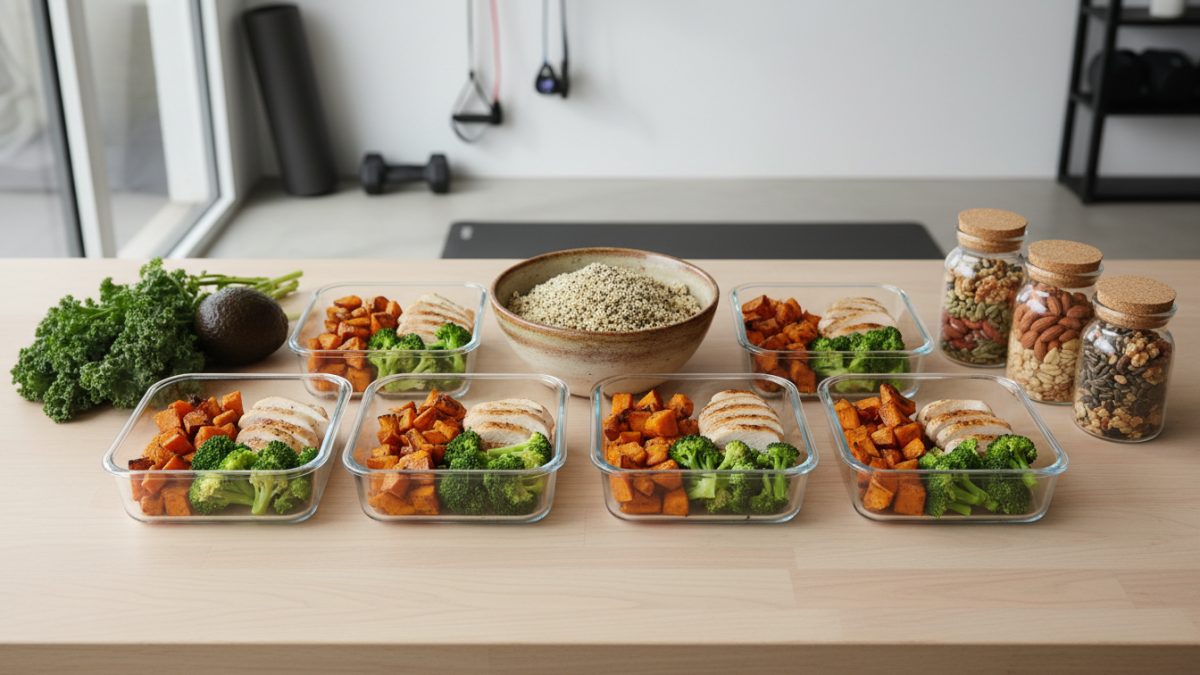
- Batch Cook Complex Carbohydrates and Proteins: Prepare staple foods like brown rice, roasted sweet potatoes, and chicken breast in bulk for two to three days in advance. Having ready-to-eat components cuts your weekday cooking time significantly.
- Apply the 80/20 Approach: If roughly 80 percent of your daily calories come from minimally processed, nutrient-dense whole foods, you can comfortably fit discretionary treats (like a slice of pizza or an ice cream) into the remaining 20 percent of your energy budget without compromising your body composition goals.
If you prefer to skip manual calculations, you can also use FitroLab to get personal nutrition targets and meal plans. If you have a medical condition, food intolerances, are pregnant or breastfeeding, or have a history of disordered eating, consult a registered dietitian or doctor before making significant dietary changes.
Frequently asked questions
How often should I adjust my meal plan?
Review your nutrition plan every 2 to 4 weeks. Calculate your weekly average weight by weighing yourself 3 to 4 mornings per week under consistent conditions, such as after using the bathroom and before eating or drinking. If your average weight has not moved in your desired direction over two to three weeks and your adherence has been consistent, adjust your daily calorie target up or down by about 100 to 200 calories.
Do I need to weigh all my food with a kitchen scale?
Weighing your food with a digital scale for the first 2 to 3 weeks is very helpful for learning what standard serving sizes and calorie densities actually look like. Once you develop an accurate mental reference for portion sizes, you can transition to estimating many of your meals by eye, as long as your weekly body weight trend and training performance stay aligned with your goals.
How do I handle dining out at restaurants?
Select dishes that feature a clear, whole-food protein source such as grilled chicken, steak, fish, or tofu, paired with potatoes, rice, or steamed vegetables. Ask for dressings and rich sauces on the side so you can control the quantity used. Log restaurant meals with a modest calorie buffer, and keep your other meals earlier in the day slightly leaner and higher in protein.
Should my calories differ on training days versus rest days?
For most people, keeping calories and macros fairly consistent across training and rest days is the simplest approach, because overall intake across the week matters most. If you prefer, you can shift a bit more of your carbohydrates toward training days and eat slightly fewer on rest days, as long as your weekly calories and protein stay aligned with your goal.