5-Day Workout Routine: Complete Muscle-Building Guide
· 7 min read

A complete, balanced 5-day workout routine designed to build muscle and increase strength without burning out your joints or recovery capacity.
Training five days per week can be a practical way to spread your weekly training volume across shorter, more focused sessions. A well-designed 5-day workout routine can support muscle gain while keeping individual workouts manageable, but the best split depends on your schedule, exercise selection, and recovery. For this format, a balanced plan works better than isolating every muscle group into its own day.
How to Structure a 5-Day Workout Routine
A common problem with five-day programming is stacking too much pressing, rowing, or lower-back work on consecutive days. A better setup spaces those stressors out so you can train hard without turning the end of the week into a fatigue management problem.
For this article, the most useful layout is a balanced 5-day split built around the actual weekly structure below:
- Day 1: Chest & Triceps
- Day 2: Back & Biceps
- Day 3: Legs & Core
- Day 4: Shoulders & Abs
- Day 5: Full Body Power
- Days 6 and 7: Rest
That layout gives you focused upper-body days early in the week, a dedicated lower-body session in the middle, and a final day for heavier compound lifts without repeating the same pattern five days in a row. In FitroLab's plan builder, the muscle-building defaults for this goal are 4 x 6-10 on compound lifts with 150 seconds of rest and 3 x 10-15 on isolation lifts with 90 seconds of rest, while weekly set targets vary by muscle group.
The Complete 5-Day Muscle-Building Program
The following program uses standard barbell, dumbbell, cable, and machine equipment commonly found in commercial gyms. Warm up before each session with 5 to 10 minutes of light cardio and dynamic mobility, followed by two to three lighter warm-up sets on the first compound exercise.
| Day | Focus | Exercise | Sets x Reps | Rest |
|---|---|---|---|---|
| Day 1 | Chest & Triceps | Barbell Flat Bench Press | 4 x 6-10 | 150 s |
| Incline Dumbbell Press | 4 x 6-10 | 150 s | ||
| Cable Chest Flye | 3 x 10-15 | 90 s | ||
| Triceps Rope Pushdown | 3 x 10-15 | 90 s | ||
| Overhead Dumbbell Triceps Extension | 3 x 10-15 | 90 s | ||
| Day 2 | Back & Biceps | Barbell Bent-Over Row | 4 x 6-10 | 150 s |
| Lat Pulldown or Pull-Up | 4 x 6-10 | 150 s | ||
| Seated Cable Row | 3 x 10-15 | 90 s | ||
| Barbell Biceps Curl | 3 x 10-15 | 90 s | ||
| Incline Dumbbell Curl | 3 x 10-15 | 90 s | ||
| Day 3 | Legs & Core | Barbell Back Squat or Leg Press | 4 x 6-10 | 150 s |
| Romanian Deadlift | 4 x 6-10 | 150 s | ||
| Dumbbell Walking Lunge | 3 x 10-15 / leg | 90 s | ||
| Leg Extension | 3 x 10-15 | 90 s | ||
| Standing or Seated Calf Raise | 3 x 10-15 | 90 s | ||
| Hanging Leg Raise | 3 x 10-15 | 90 s | ||
| Day 4 | Shoulders & Abs | Seated Overhead Dumbbell Press | 4 x 6-10 | 150 s |
| Dumbbell Lateral Raise | 3 x 10-15 | 90 s | ||
| Cable Face Pull | 3 x 10-15 | 90 s | ||
| Reverse Pec Deck Flye | 3 x 10-15 | 90 s | ||
| Cable Woodchopper | 3 x 10-15 / side | 90 s | ||
| Day 5 | Full Body Power | Barbell Front Squat or Hack Squat | 4 x 6-10 | 150 s |
| Romanian Deadlift or Hip Thrust | 4 x 6-10 | 150 s | ||
| Flat Dumbbell Press or Machine Chest Press | 4 x 6-10 | 150 s | ||
| Chest-Supported Row | 4 x 6-10 | 150 s | ||
| Seated Dumbbell Overhead Press | 3 x 10-15 | 90 s |
Day 1: Chest & Triceps
Start with the barbell bench press and incline dumbbell press while you are fresh, then move to flyes for chest volume without more heavy joint loading. Finish with two triceps isolations so pressing muscles get extra work without turning the whole day into a long push workout.
Day 2: Back & Biceps
Use one horizontal pull and one vertical pull as the backbone of the session, then add a secondary row for more upper-back volume. Finish with two curl variations so the biceps get direct work after your heavier back exercises.
Day 3: Legs & Core
Build the session around a squat or leg press plus a hip hinge, then add a single-leg movement and leg extensions for extra quad volume. Calf raises and hanging leg raises round out the day without making it excessively long.
Day 4: Shoulders & Abs
Keep one compound press, then use lateral and rear-delt work to cover the shoulder heads that presses do not train well on their own. Add one direct abs movement at the end to keep core work distributed through the week.
Day 5: Full Body Power
The fifth session ties the split together with compound lifts for legs, chest, back, and shoulders. Keep the exercise list short, rest fully between hard sets, and stop a rep or two before form breaks down so you can finish the week strong rather than just accumulating fatigue.
Scheduling Your Rest Days
There are two practical ways to place the five sessions across a normal week:
Option A: Monday to Friday
- Monday: Chest & Triceps
- Tuesday: Back & Biceps
- Wednesday: Legs & Core
- Thursday: Shoulders & Abs
- Friday: Full Body Power
- Saturday: Rest
- Sunday: Rest
This works well if you want weekends free, but five consecutive training days can feel demanding by Friday.
Option B: 2-on, 1-off, 3-on, 1-off
- Monday: Chest & Triceps
- Tuesday: Back & Biceps
- Wednesday: Rest
- Thursday: Legs & Core
- Friday: Shoulders & Abs
- Saturday: Full Body Power
- Sunday: Rest
A mid-week break often helps if your legs or lower back feel flat later in the week, or if work stress makes five straight sessions unrealistic.
How to Progress on a 5-Day Split
To build muscle consistently over months, use a simple rep-progression approach instead of trying to force load increases every workout.
- Pick a load that lets you reach the bottom of the rep range with solid form and about 1 to 3 reps in reserve.
- Keep the same load until your reps improve across the prescribed sets.
- When you reach the top of the rep range on all working sets, increase the load by the smallest available increment if your equipment allows.
- If your gym has large jumps between dumbbells or machines, keep the load the same and improve technique, pause quality, or total reps first.
For example, if your incline dumbbell press target is 4 x 6-10, you might get 10, 9, 8, and 7 in week one. Once you can complete 10 reps on all four sets with clean technique, move to the next heavier pair if it feels appropriate.
Because equipment jumps vary so much between gyms, think of progression as improving performance over time rather than following fixed weight increases every session.
Adapting the 5-Day Routine for Home and Condo Gyms
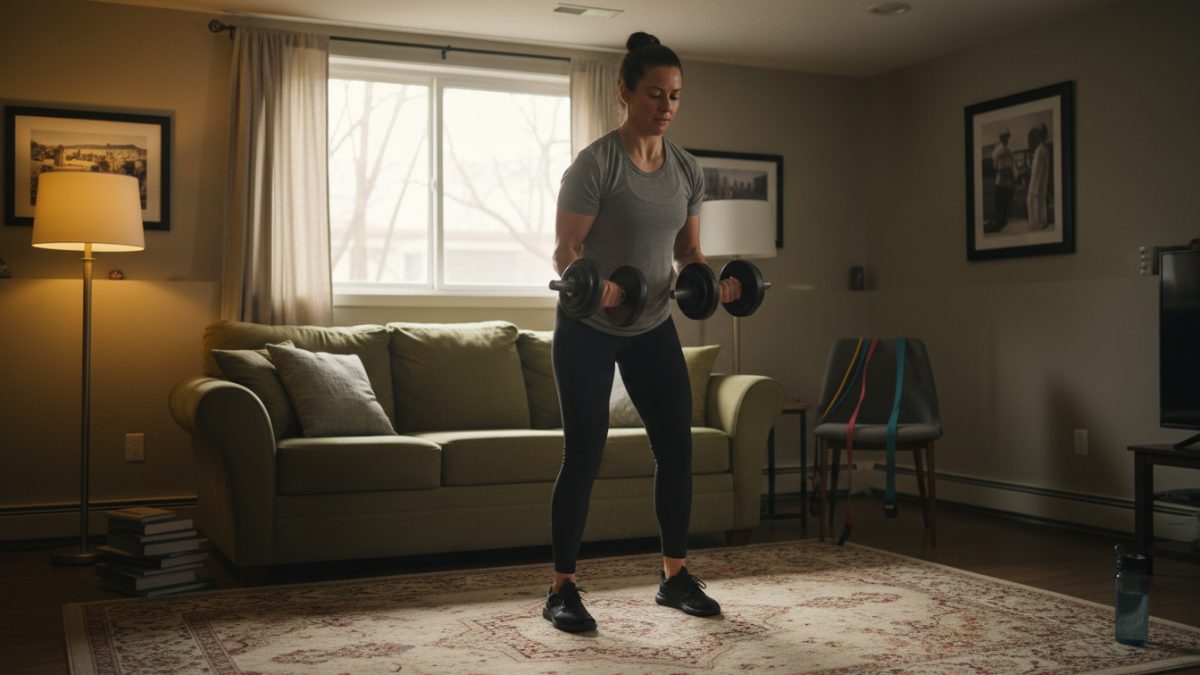
If you train at home or in a condo gym with limited equipment, keep the same day structure and swap exercises based on movement pattern rather than trying to copy the gym version exactly.
| Gym exercise | Home or condo substitute |
|---|---|
| Barbell Flat Bench Press | Flat Dumbbell Bench Press or Weighted Push-Up |
| Barbell Bent-Over Row | Chest-Supported Dumbbell Row or One-Arm Dumbbell Row |
| Barbell Back Squat | Goblet Squat or Bulgarian Split Squat |
| Romanian Deadlift | Dumbbell Romanian Deadlift |
| Lat Pulldown | Pull-Up, Band Pulldown, or One-Arm High Cable Row |
| Reverse Pec Deck | Incline Rear-Delt Flye |
| Cable Pushdown | Dumbbell Skull Crusher or Band Pushdown |
| Cable Woodchopper | Dead Bug, Side Plank, or Band Woodchopper |
The goal is not to find perfect one-to-one replacements. The goal is to keep a press, a row or pull, a squat pattern, a hinge, and a few isolation movements in each week.
Frequently asked questions
Can a beginner use a 5-day workout routine?
Beginners can use a five-day split, but they generally progress faster and recover better on a 3-day full body or 4-day upper/lower routine. New lifters do not require five distinct sessions per week to trigger muscle protein synthesis. If you are in your first six months of structured lifting, starting with three or four days per week allows you to practice key motor patterns more frequently without accumulating excess muscle soreness.
How long should each workout take on a 5-day split?
A well-structured five-day workout should take between 45 and 65 minutes, excluding your general warm-up. Because the work is divided into four to six exercises per muscle group per day, you do not need to spend 90 minutes in the gym. Stick closely to your designated rest intervals (150 seconds for compounds, 90 seconds for isolations) to keep the session within this timeframe.
Is a 5-day split suitable for fat loss?
It can be, as long as you recover well and keep the workload realistic for your calorie intake, sleep, and stress levels. During a fat-loss phase, strength training helps you hold on to muscle, but some people do better with slightly less volume or one fewer training day when recovery drops.
If you want a customised routine built around your equipment, schedule, and recovery capacity, you can build one in FitroLab.
This article was written with AI and checked by an automated editor. It is general information, not medical advice: talk to a health professional before starting a new training or nutrition plan. How we write our articles