Cable Machine Workout Routine: Full-Body Muscle Plan
· 8 min read
A practical 3-day cable machine workout routine for building balanced full-body muscle. Includes exercise setups, weekly tables, and easy adjustments.
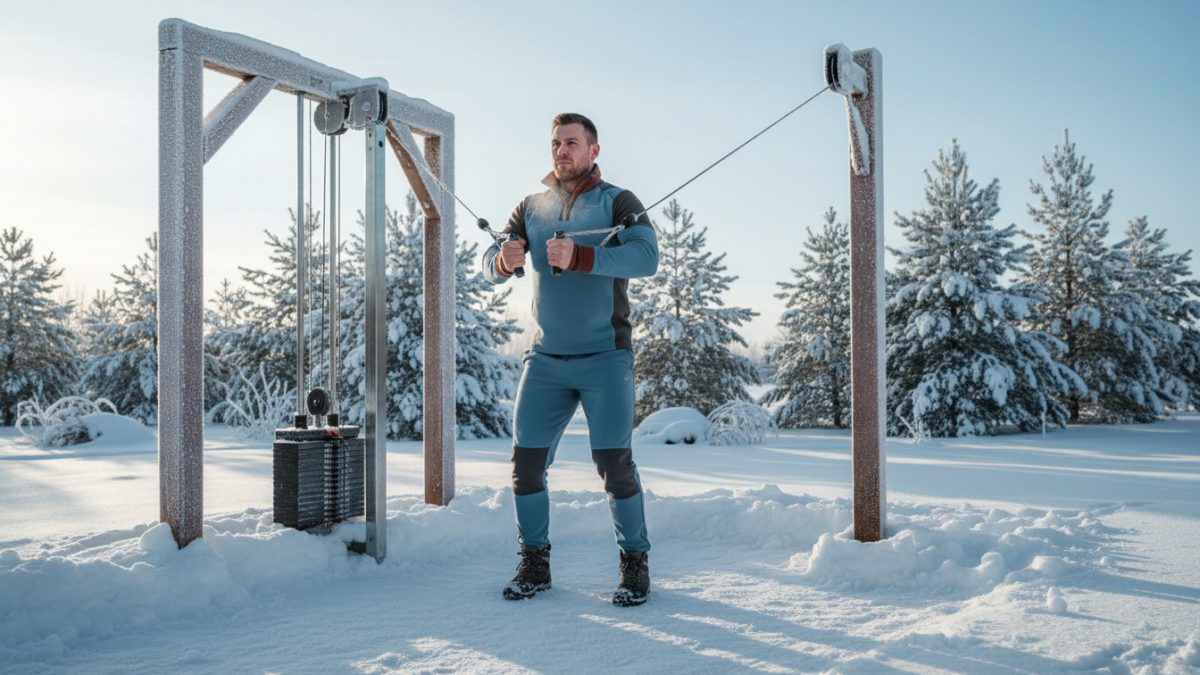
Cables can keep muscles loaded through parts of a lift where free weights sometimes feel easier, although the exact resistance profile depends on the exercise and setup. This cable machine workout routine shows one practical way to train your whole body with a dual adjustable pulley station and a few basic attachments.
Say you can train three days a week on non-consecutive days—such as Monday, Wednesday, and Friday—in a busy commercial gym or a condo fitness room where barbells and heavy dumbbells are either unavailable or constantly taken. You have access to a standard dual-column cable station, regular D-handles, a straight bar attachment, a rope attachment, and an ankle strap.
Here is how that three-day full-body routine is laid out across the week:
| Day | Exercise | Target Muscle | Sets x Reps | Rest |
|---|---|---|---|---|
| Day 1: Full Body A | Cable Romanian deadlift | Hamstrings & glutes | 4 x 8–10 | 150 s |
| Standing dual cable chest press | Chest & triceps | 4 x 6–10 | 150 s | |
| Kneeling lat pulldown | Lats & upper back | 4 x 8–10 | 150 s | |
| Cable lateral raise | Side deltoids | 3 x 10–15 | 90 s | |
| Overhead cable triceps extension | Triceps | 3 x 10–15 | 90 s | |
| Cable biceps curl with straight bar | Biceps | 3 x 10–15 | 90 s | |
| Day 2: Full Body B | Cable belt squat or goblet squat | Quads & glutes | 4 x 8–10 | 150 s |
| Seated cable low row | Mid-back & rhomboids | 4 x 6–10 | 150 s | |
| Low-to-high cable chest flye | Upper chest | 3 x 10–15 | 90 s | |
| Cable pull-through | Glutes & hamstrings | 3 x 10–12 | 120 s | |
| Cable rope face pull | Rear deltoids & upper back | 3 x 12–15 | 90 s | |
| Cable kneeling crunch | Core (abs) | 3 x 12–15 | 60 s | |
| Day 3: Full Body C | Single-leg cable Romanian deadlift | Hamstrings, glutes & balance | 3 x 10–12 per side | 90 s |
| Incline cable chest press | Upper chest & front deltoids | 4 x 8–10 | 150 s | |
| Half-kneeling single-arm cable row | Lats & mid-back | 4 x 8–10 per side | 120 s | |
| Cable upright row | Deltoids & upper traps | 3 x 10–12 | 90 s | |
| Cable hammer curl with rope | Biceps & brachialis | 3 x 10–15 | 90 s | |
| Cable rope triceps pushdown | Triceps | 3 x 10–15 | 90 s |
Why this week is arranged this way
Each session starts with the most demanding lower-body lift, then pairs one press and one pull before finishing with smaller isolation work. That order keeps setup simple on a cable station and helps you put more effort into the lifts that usually need the most coordination and load.
Day 1 breakdown
The cable Romanian deadlift starts the week with a hip hinge. Set both pulleys low, hold the handles at your sides or just in front of your thighs, and step back enough to keep tension on the cables. The slight forward pull encourages you to sit the hips back while keeping the torso braced.
The standing dual cable chest press follows. Set the pulleys around mid-chest height and use a staggered stance so you can press forward without leaning back. Kneeling lat pulldowns add a vertical pull when you do not have a separate pulldown station; kneel between the high pulleys and pull the handles down toward your upper chest while keeping your ribs stacked over your hips.
The session finishes with single-joint work: lateral raises for the side deltoids, overhead extensions for triceps, and straight-bar curls for biceps.
Day 2 breakdown
Day 2 shifts the lower-body focus toward a squat pattern with the cable squat. You can attach a dip belt around your waist if your gym setup allows it, or hold two low-pulley handles at shoulder height in a goblet-style position.
The seated cable low row provides a stable horizontal pull for the mid-back. Low-to-high flyes bias the upper chest fibres, while cable pull-throughs add more hip-hinge volume for glutes and hamstrings with relatively little knee stress. Face pulls train the rear deltoids and upper back, and kneeling crunches give you direct core work with constant cable tension.
Day 3 breakdown
Day 3 introduces unilateral lower-body work with the single-leg cable Romanian deadlift. Holding the cable on the opposite side of your working leg adds an anti-rotation demand and makes the movement more stable than using no external support at all.
The incline cable press sets the pulleys low so you press upward at roughly a 30-degree to 45-degree angle, which usually biases the upper chest more than a flat press. The half-kneeling single-arm row allows a long reach forward before you pull the elbow back toward the hip. Cable upright rows, rope hammer curls, and rope triceps pushdowns round out the shoulder and arm work.
If you want to build a similar plan inside FitroLab, the muscle-building defaults for compounds and isolations here match its builder: 4 sets of 6–10 reps with 150 seconds of rest for compound lifts, and 3 sets of 10–15 reps with 90 seconds of rest for isolation lifts.
Adjusting for harder or easier cable stacks
Cable stacks vary a lot between gyms, and the numbers on two machines do not always feel the same. On some towers, one pin jump is small; on others, it is a big increase, especially for lateral raises, curls, and triceps work.
A simple way to adjust is to stay with the same setting until you can hit the top of the rep range on all sets with clean technique. If the next pin jump is too large, add reps first, slow the lowering phase slightly, pause briefly in the hardest position, or switch to a more stable variation before increasing the load.
If your gym has small add-on weights, they can make isolation lifts easier to progress in smaller steps.
Adjusting this cable machine workout routine for less time
If you only have 35 to 40 minutes per workout instead of an hour, you can trim the plan to four high-impact exercises per session while keeping the weekly balance intact:
- Day 1 Express: Cable Romanian deadlift (3 sets), standing dual cable chest press (3 sets), kneeling lat pulldown (3 sets), and cable lateral raise (3 sets).
- Day 2 Express: Cable belt squat (3 sets), seated cable low row (3 sets), low-to-high cable flye (3 sets), and cable face pull (3 sets).
- Day 3 Express: Single-leg cable Romanian deadlift (3 sets per side), incline cable press (3 sets), half-kneeling row (3 sets per side), and cable rope triceps pushdown (3 sets).
You can also superset the final isolation movements—pairing lateral raises with triceps pushdowns, for example—since they train non-competing muscle groups and need minimal setup changes.
Adjusting for more training experience
Lifters with two or more years of consistent training often benefit from distributing their volume across a 4-day upper and lower split. This creates room for dedicated direct calf and hamstring work:
- Upper Day 1: Dual cable chest press, seated low row, cable lateral raise, and overhead triceps extension.
- Lower Day 1: Cable Romanian deadlift, cable belt squat, standing cable calf raise (using an ankle strap or standing on a plate), and cable kneeling crunch.
- Upper Day 2: Incline cable chest press, kneeling lat pulldown, cable face pull, and cable hammer curl.
- Lower Day 2: Cable reverse lunges, single-leg cable hamstring curls (with an ankle strap attached to the low pulley), cable pull-throughs, and cable woodchoppers.
This 4-day split spreads weekly volume across more frequent, focused workouts while allowing 48 to 72 hours of recovery for each muscle group between sessions.
Adjusting for limited cable attachments
If your gym only provides basic D-handles and lacks a long straight bar or rope attachment, you can easily substitute movements without changing the targeted muscles:
- Replace straight-bar curls with single-arm handle curls.
- Replace rope triceps pushdowns with single-arm cross-body extensions using a bare carabiner or a single handle.
- Replace the cable belt squat by holding two single handles at collarbone height while performing standard squats.
- Replace rope face pulls with single-arm high-to-low rear delt pulls using a standard handle.
If you want a personal strength plan structured around your exact equipment and weekly schedule, FitroLab generates your complete workout program with tailored exercises, sets, reps, and rest periods.
Frequently asked questions
Can you build as much muscle with cables as with free weights?
Often, yes. Muscle growth depends mainly on getting enough hard sets, using exercises you can progress, and training close enough to failure with good technique. Free weights may be better for some lifts and heavier absolute loading, while cables can make setup and resistance direction easier for many isolation and machine-like movements.
What pulley ratio does a standard cable machine use?
Many dual adjustable pulley stations use a 2:1 ratio, meaning a 22.5 kg pin may feel like roughly half that at the handle, but this is not universal. Some machines use different pulley setups, and friction can also change how the resistance feels. Focus on rep quality and progression on that specific machine rather than comparing stack numbers across different gyms.
Do I need a weight belt for cable squats?
A dedicated dip belt or squat harness makes cable squats comfortable because the load hangs from your hips, reducing strain on your arms and lower back. If you do not have a belt, you can hold two low handles at chest height or use a single low-pulley handle held in both hands against your sternum as a goblet squat.
Free calculators for this topic
This article was written with AI and checked by an automated editor. It is general information, not medical advice: talk to a health professional before starting a new training or nutrition plan. How we write our articles