Strength Training for Runners: A Practical 2-Day Plan
· 7 min read

A complete 2-day strength routine designed for runners who want to protect their joints, improve running economy, and lift without sabotaging their weekly mileage.
Adding weights to a running schedule often backfires when leg workouts leave your quads and calves too sore to hit target paces. A proper routine for strength training for runners does not mimic a bodybuilding split; it targets tendon stiffness, single-leg stability, and force production so you become more durable on the road or trail.
Say you run three or four days a week, logging 25 to 40 km across paved paths or indoor treadmills, and you want to dedicate two 45-minute sessions per week to lifting. Your priority is to support joint health in your knees, hips, and ankles while keeping fatigue low enough that your weekend long run feels crisp.
Here is how a balanced training week looks when balancing mileage with barbell and dumbbell work:
| Day | Focus | Details | Time |
|---|---|---|---|
| Monday | Strength Day A | Lower body hinge & push, upper body pull, anti-rotation core | 45 min |
| Tuesday | Easy Run | Low-intensity aerobic pace, 5 to 8 km | 35–45 min |
| Wednesday | Rest or Mobility | Foam rolling, light walking, active recovery | 20 min |
| Thursday | Quality Run | Interval or tempo run, 6 to 10 km | 45–55 min |
| Friday | Strength Day B | Lower body squat & unilateral, upper body push, calf/foot work | 45 min |
| Saturday | Long Run | Aerobic endurance mileage, 12 to 20 km | 60–100 min |
| Sunday | Full Rest | No structured training | — |
The complete 2-day strength training for runners plan
To make strength work complement your running rather than fight it, each session relies on moderate volume and compound movement patterns. You lift heavy enough to recruit high-threshold motor units without chasing muscle exhaustion.
| Session | Exercise | Sets x Reps | Rest | Purpose for Runners |
|---|---|---|---|---|
| Day A | Trap Bar Deadlift (or Barbell RDL) | 3 x 6–8 | 150 s | Posterior chain force, glute and hamstring power |
| Day A | Single-Leg Dumbbell Step-Up | 3 x 8–10 / side | 90 s | Hip stability, unilateral balance, knee tracking |
| Day A | Chest-Supported Dumbbell Row | 3 x 8–10 | 90 s | Postural endurance for tall running mechanics |
| Day A | Half-Kneeling Pallof Press | 3 x 10–12 / side | 60 s | Pelvic control and anti-rotation against stride twist |
| Day A | Standing Dumbbell Calf Raise (Straight Leg) | 3 x 12–15 | 60 s | Gastrocnemius and Achilles tendon resilience |
| Day B | Goblet Box Squat | 3 x 6–8 | 150 s | Quad strength, hip drive, safe depth control |
| Day B | Bulgarian Split Squat | 3 x 8–10 / side | 90 s | Single-leg quad/glute strength, stride symmetry |
| Day B | Overhead Dumbbell Press | 3 x 8–10 | 90 s | Shoulder stability, arm drive efficiency |
| Day B | Seated Calf Raise (or Bent-Knee Wall Raise) | 3 x 12–15 | 60 s | Soleus strength (handles deep impact during stance phase) |
| Day B | Side Plank with Top Leg Lift | 3 x 20–30 s / side | 60 s | Lateral hip stability to prevent knee collapse (valgus) |
Why these exercises are programmed this way
Running is an alternating series of single-leg landings and push-offs. Ground-reaction forces during running are substantial, and how they are distributed depends on speed, stride mechanics, footwear, and the surface. Strengthening your glutes, hamstrings, and calves can help you tolerate training better, but it does not guarantee that stress shifts away from any one tissue.
The trap bar deadlift and goblet squat develop general hip and knee extension strength with clean spinal mechanics. These are paired with unilateral movements like step-ups and Bulgarian split squats because running happens one leg at a time; bilateral lifting alone often masks left-to-right strength discrepancies.
The plan also includes dedicated calf work. The soleus muscle, which is emphasized in bent-knee calf raises, contributes heavily during running and helps handle repeated loading. Training both straight-leg and bent-knee calf variations can build lower-leg strength and capacity, which may help runners tolerate training better over long blocks of road work.
If you want a personal version of this, FitroLab can generate a plan with exercises, sets, reps, rest, nutrition targets, and plan reviews. For this runner-friendly setup, keep the main lifts at 3 sets of 6 to 8 reps with long rests and avoid adding extra volume just because you feel fresh that day.
How to adjust the plan for home or condo gym equipment
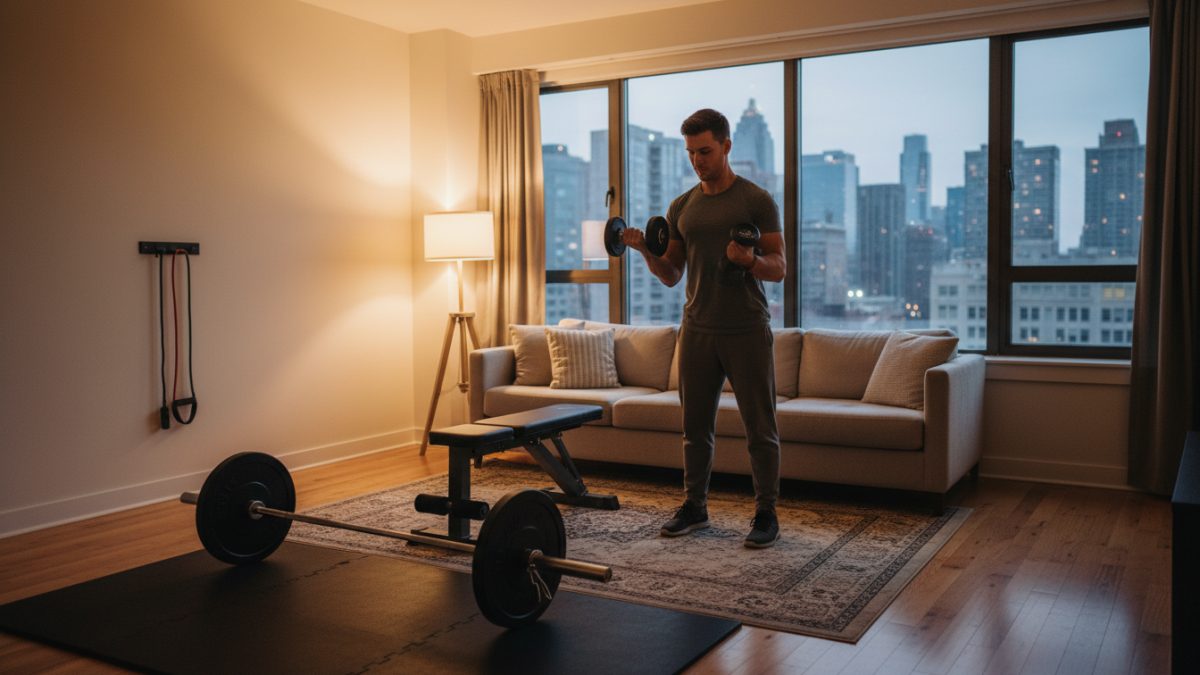
If you train in a basic condo gym or at home with only a pair of adjustable dumbbells and resistance bands, you do not need heavy barbells to build durable running legs.
Replace the trap bar deadlift with a double-dumbbell Romanian deadlift, using a load you can control with good form and focusing on a controlled 3-second lowering phase. Swap the barbell box squat for a dumbbell goblet squat or an offset front rack squat.
If your dumbbell weights are light, increase time under tension instead of turning the workout into a high-rep cardio circuit. Lower yourself over 3 to 4 seconds, pause for 1 second at the bottom, and drive up smoothly. This maintains mechanical tension on tendons and muscle fibres without requiring commercial gym plates.
How to adjust the routine during peak running mileage
When your weekly running mileage climbs in the final 6 to 8 weeks before a target race, recovery often becomes the limiting factor. You do not need to drop lifting entirely, but many runners do better with a lower-maintenance approach so they can keep some strength work in without interfering with key runs.
Instead, scale back to a maintenance volume:
- Reduce total working sets from 3 sets down to 2 sets per exercise.
- Keep the load moderate (stop each set roughly 2 to 3 reps shy of failure).
- Drop the total workout duration to 25 or 30 minutes.
- Schedule your lifting sessions on your hard running days (e.g., lift 4 to 6 hours after a Tuesday interval session) to keep your designated rest days completely free of fatigue.
During your final taper week (7 to 10 days before race day), complete one short session using bodyweight or light bands, focusing on mobility and activation rather than heavy resistance.
How to progress the plan as you get stronger
Once you can complete all prescribed sets and reps with clean form for two consecutive weeks, adjust the challenge using simple double progression:
- Pick a working weight where you hit the bottom of the rep range (e.g., 6 reps on Romanian deadlifts with 35 lb [16 kg] dumbbells).
- Over subsequent weeks, add reps until you reach the top of the range (e.g., 8 reps per set with that same load).
- Once you hit 3 sets of 8 reps with crisp technique, increase the load by 5 to 10 lb [2 to 5 kg] total and reset to 6 reps.
After 8 to 12 weeks of consistent lifting, some runners can introduce basic plyometrics at the start of a gym session, such as 2 to 3 sets of 3 to 5 low box jumps or light pogo hops. Keep contacts low, stop well before fatigue, and skip them if you are dealing with calf, Achilles, foot, or knee pain; if that applies, speak with a physiotherapist or doctor before adding impact work.
Frequently asked questions
Should I lift weights before or after my run?
If you must train both on the same day, prioritize your primary goal for that cycle. For distance runners, complete your priority run first, rest at least 4 to 6 hours, and then lift. If you must do them back-to-back, run first and keep your lifting loads moderate to avoid technique breakdown from running fatigue.
Will lifting weights make me too bulky for distance running?
Building noticeable muscle mass usually requires a higher training volume, enough food to support growth, and time. A 2-day low-volume routine paired with 25 to 50 km of weekly running is unlikely to add much mass for most runners, while it can still improve strength and may support running economy.
What should I do if my legs are sore on long run days?
Delayed onset muscle soreness usually peaks 24 to 48 hours after introducing new exercises or heavier loads. Ensure there are at least 24 hours (ideally 48) between a lower-body lifting session and your longest run of the week. If soreness persists, reduce your gym volume by one set per exercise until your body adapts.
If you want to turn this example into a plan that matches your equipment, mileage, and schedule, use FitroLab to generate a personalized routine.
Free calculators for this topic
This article was written with AI and checked by an automated editor. It is general information, not medical advice: talk to a health professional before starting a new training or nutrition plan. How we write our articles