Machine Only Workout Plan: Build Muscle on Gym Machines
· 7 min read
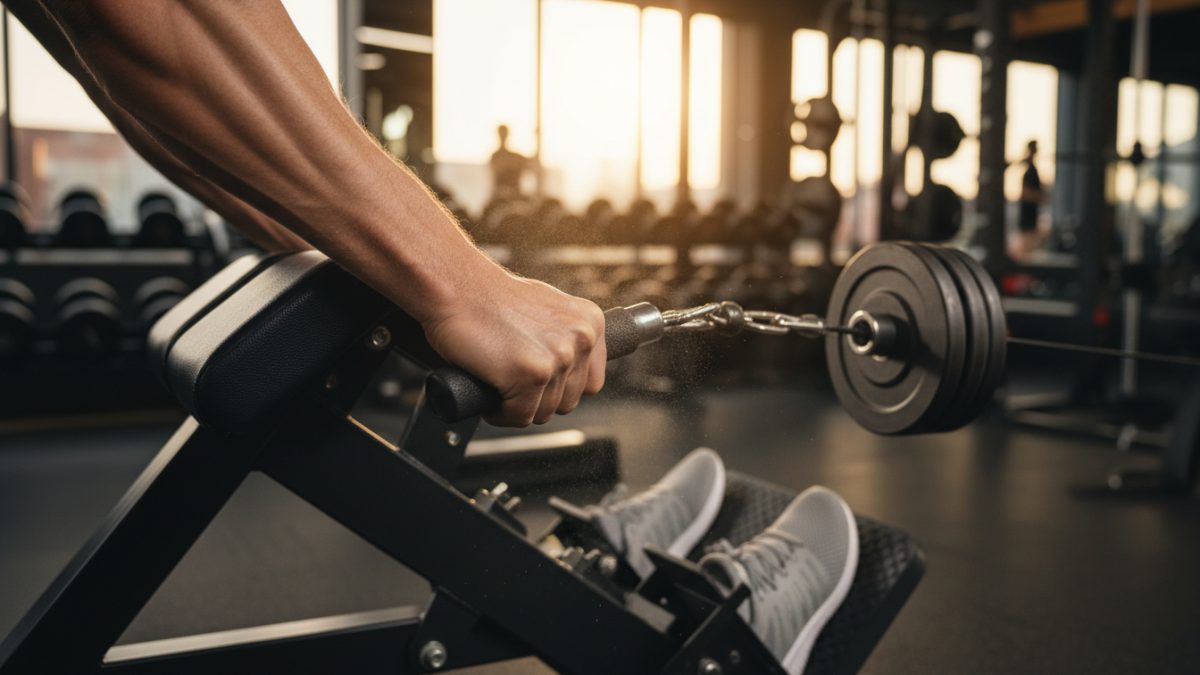
A complete 4-day machine only workout plan to build muscle, reduce joint stress, and bypass crowded free-weight areas in your gym.
Machines are a practical way to train for muscle gain when you want a simpler setup, more support, or less competition for barbells and benches. If crowded free-weight areas, lower-back fatigue from unsupported lifts, or a preference for stable exercise paths are limiting your training, a machine only workout plan can still give you enough hard sets to grow.
Say you train four days a week at a commercial gym and want to build muscle without loading your spine with heavy barbells or waiting for flat benches. You have access to standard cable stations, pin-loaded selectorized units, and plate-loaded leverage machines. Here is what a complete four-day upper/lower week looks like, programmed with clear set counts, rep targets, and rest intervals.
| Day | Exercise | Muscle group | Working sets | Target reps | Rest |
|---|---|---|---|---|---|
| Day 1: Upper A | Chest-supported machine row | Back | 4 | 6–10 | 150 s |
| Converging chest press machine | Chest | 4 | 6–10 | 150 s | |
| Lat pulldown (wide neutral grip) | Back | 3 | 10–12 | 90 s | |
| Machine shoulder press | Shoulders | 3 | 8–10 | 150 s | |
| Cable lateral raise | Shoulders | 3 | 12–15 | 90 s | |
| Cable triceps pushdown | Arms | 3 | 10–15 | 90 s | |
| Day 2: Lower A | Hack squat or pendulum squat | Legs (quads/glutes) | 4 | 6–10 | 150 s |
| Seated leg curl | Legs (hamstrings) | 4 | 8–12 | 90 s | |
| 45-degree leg press (high foot placement) | Legs (glutes/quads) | 3 | 10–12 | 150 s | |
| Standing or seated calf raise machine | Legs (calves) | 4 | 10–15 | 90 s | |
| Cable woodchopper or kneeling cable crunch | Core | 3 | 12–15 | 60 s | |
| Day 3: Rest | Active recovery or walking | — | — | — | — |
| Day 4: Upper B | Incline plate-loaded chest press | Chest | 4 | 6–10 | 150 s |
| Neutral-grip seated cable row | Back | 4 | 8–12 | 150 s | |
| Pec deck (machine chest fly) | Chest | 3 | 10–15 | 90 s | |
| Machine reverse fly (rear deltoid) | Shoulders | 3 | 12–15 | 90 s | |
| Cable bayesian curl or preacher machine curl | Arms | 3 | 10–15 | 90 s | |
| Overhead cable triceps extension | Arms | 3 | 10–15 | 90 s | |
| Day 5: Lower B | Lying leg curl | Legs (hamstrings) | 4 | 8–12 | 90 s |
| Leg extension | Legs (quads) | 4 | 10–15 | 90 s | |
| Single-leg leg press | Legs (quads/glutes) | 3 | 10–12 | 120 s | |
| Machine hip abduction | Legs (glutes) | 3 | 12–15 | 60 s | |
| Machine crunch | Core | 3 | 10–12 | 60 s | |
| Day 6–7: Rest | Rest days | — | — | — | — |
Why each exercise and parameter is chosen
Starting Upper A with a chest-supported row eliminates balance constraints and lets you drive your elbows back with maximum intent, targeting the mid-back and lats without fatiguing the erectors in your lower spine. Following it with a converging chest press matches the natural arc of your arms, placing clean tension on your pectorals at both the stretch and contracted positions.
On lower-body days, the hack squat gives you a stable way to train the quads and glutes hard without having to balance a bar. Pairing it with leg curls and a 45-degree leg press gives you substantial lower-body volume while reducing the need for unsupported spinal loading. Rest times stay simple: compound presses, rows, and squats use 150 seconds so performance holds up across sets, while single-joint isolation work uses 90 seconds.
This setup also lines up with the build-muscle defaults many lifters use: 4 working sets of 6 to 10 reps with 150 seconds of rest for compound exercises, and 3 sets of 10 to 15 reps with 90 seconds of rest for isolation lifts. Across the week, that gives you roughly 11 direct sets for chest, 11 for back, 9 for shoulders, 6 direct sets each for biceps and triceps plus extra work from presses and rows, 18 for legs, and 6 for core.
How to progress on a machine only workout plan
Machines make tracking objective progress straightforward because handle angles, lever arms, and pulleys remain constant across sessions. Use double progression across your working sets:
- Select a pin weight where you reach technical fatigue near the bottom of your prescribed rep range (for example, 6 reps on a 6–10 target).
- Keep that same weight across subsequent workouts until you can complete all prescribed sets at the top of the range (10 reps on every set) with controlled tempo.
- Increase the weight by the smallest pin increment (often 5 lb to 10 lb [2.3 kg to 4.5 kg]) or use the small fractional add-on weights found on selectorized stacks, which will drop your reps back toward 6.
Because the machine guides the path, many people find it easier to train close to muscular failure on these exercises while keeping technique consistent. Keep your eccentric phase controlled for 2 to 3 seconds, pause briefly in the stretched position when appropriate, and avoid letting the weight stack slam between repetitions.
Adjusting the plan for 3 days per week
If work schedules or commuting limit you to three gym visits, condense the upper/lower framework into a three-day full body rotation. Run your workouts on non-consecutive days, such as Monday, Wednesday, and Friday.
- Full Body A: Hack squat (4 sets, 6–10 reps), converging chest press (4 sets, 6–10 reps), lat pulldown (3 sets, 8–12 reps), seated leg curl (3 sets, 10–12 reps), cable lateral raise (3 sets, 12–15 reps).
- Full Body B: 45-degree leg press (4 sets, 8–12 reps), chest-supported machine row (4 sets, 6–10 reps), machine shoulder press (3 sets, 8–10 reps), leg extension (3 sets, 10–15 reps), cable triceps pushdown (3 sets, 10–15 reps).
- Full Body C: Incline machine chest press (4 sets, 6–10 reps), neutral-grip seated cable row (4 sets, 8–12 reps), lying leg curl (4 sets, 8–12 reps), pec deck (3 sets, 10–15 reps), preacher machine curl (3 sets, 10–15 reps).
This setup preserves total weekly volume for major muscle groups while distributing leg and upper-body fatigue evenly across the week.
Adjusting for limited gym equipment
Not every facility features modern leverage machines or hack squats. If your gym has a standard multi-station cable tower and older selectorized units, substitute equivalent movement patterns:
- No hack squat: Use a traditional 45-degree leg press with feet placed low on the platform for quad emphasis, or set up a cable squat with a waist belt.
- No chest-supported row: Sit facing a low cable pulley with a close-grip handle, or use a single-arm cable row seated on a utility bench.
- No converging press: Use a standard flat chest press machine or bilateral cable presses standing between two adjustable pulley columns.
- No lying leg curl: Perform seated leg curls with a slower eccentric, or use a cable pull-through or glute-focused hip hinge variation if your gym setup allows it.
Match the primary joint motion (horizontal push, vertical pull, knee flexion, hip extension) rather than hunting for an identical brand name.
Adjusting for advanced lifters and high volume
Lifters with several years of consistent training sometimes benefit from higher weekly set counts or carefully chosen intensity techniques. Machines can be a practical place to use these methods because setup is stable, but they still require control and good judgment, especially as fatigue builds:
- Drop sets: On your final set of leg extensions, pec deck, or cable curls, perform reps to technical failure, reduce the pin load by roughly 20%, and immediately perform as many clean reps as possible.
- Lengthened partials: Once full range of motion stalls on exercises where the peak tension occurs in the stretched position (such as seated leg curls or machine chest presses), perform 4 to 6 controlled partial reps out of the deep stretch before racking the stack.
- Volume increases: Add one working set to your primary compound movements, moving from 4 sets to 5 sets per exercise, provided your recovery and sleep sustain the extra workload.
Frequently asked questions
Can you build as much muscle on machines as with free weights?
Often, yes. Muscle growth depends mainly on hard, well-targeted sets over time, not on whether the resistance comes from a barbell, dumbbell, cable, or machine. In practice, both machines and free weights can work well for hypertrophy, and the better choice is often the one you can train hard and consistently with.
Should beginners start with machines or free weights?
Beginners can start with either. Machines allow new lifters to learn movement paths, build initial strength, and push working sets safely without complex balance demands. However, learning basic bodyweight hip hinges and squats alongside machine work helps build fundamental coordination.
Do machines burn fewer calories than free weights?
Sometimes, but it is not a useful reason to choose one over the other. Total energy expenditure depends much more on how much work you do across the session, your body size, your rest periods, and how long you train than on whether an exercise uses a machine or a free weight.
If you want a personal plan built around your available equipment, weekly schedule, and target reps, you can build one in FitroLab.
This article was written with AI and checked by an automated editor. It is general information, not medical advice: talk to a health professional before starting a new training or nutrition plan. How we write our articles